
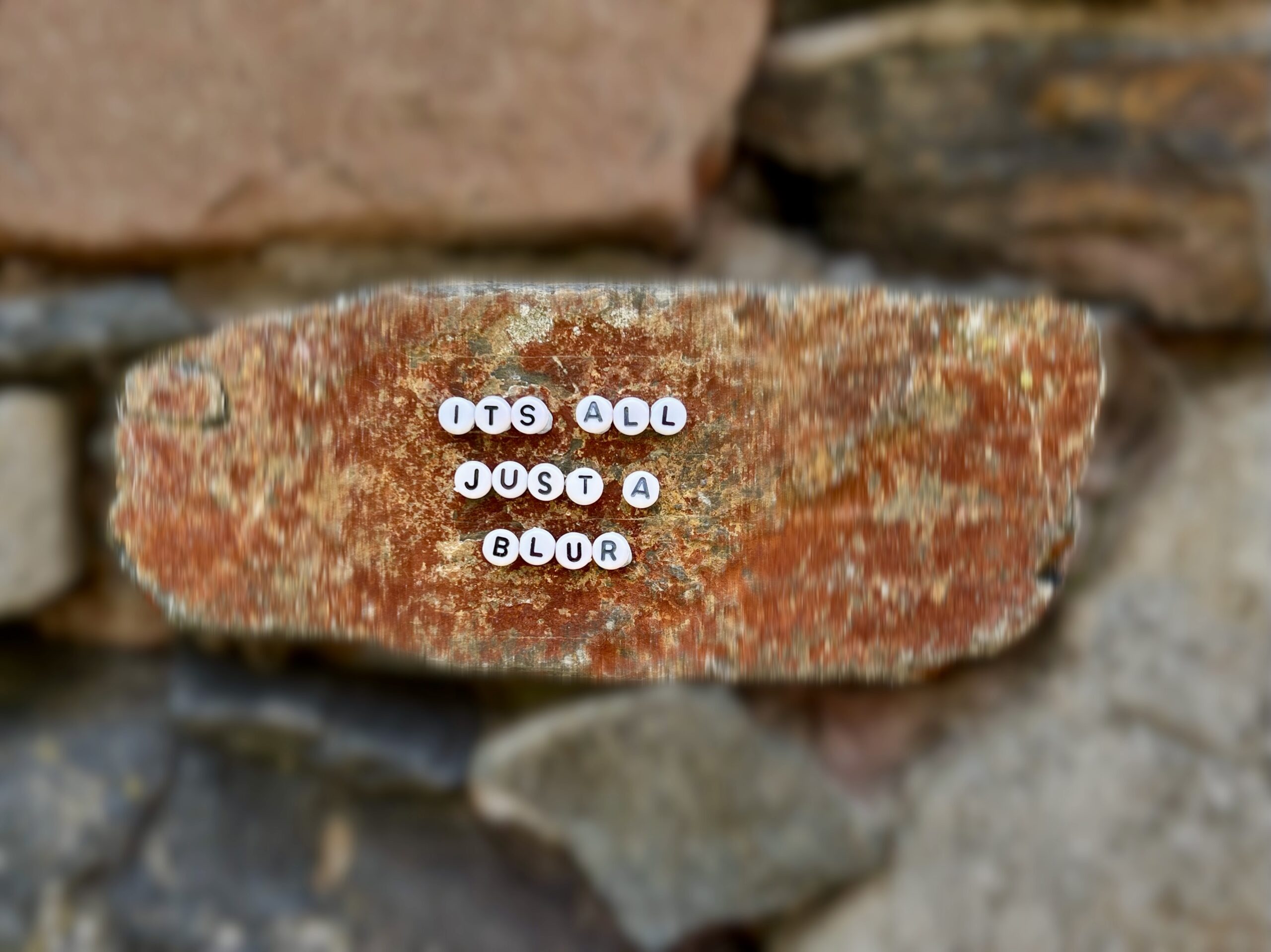
It’s all just a blur
It’s taken me two years to find the right words to describe my symptoms and to connect the dots of my experience. That is the reality of a mild Traumatic Brain Injury (mTBI) and Post-Concussion Syndrome (PCS); you are living through a physical experience you cannot put into language because, as Taylor sings,
“It’s all just a blur.”
To make sense of this blur, I’ve begun to view my recovery as a mosaic, a collection of a dozen different symptoms, broken pieces each with its own jagged edges that form the person I am today. The hardest part is that these fragments rarely exist in isolation; most of them happen all at once, overlapping and amplifying one another. So this post is a dive into the fragments of my PCS mosaic.
The first piece is the brain fog. I had never experienced this before my accident, so those first few days felt entirely overwhelming. Everyone describes brain fog differently. For me, it feels like having cotton wool stuffed between my eyes and my brain. It creates a suffocating pressure in my eyes and sinuses, making it impossible to think clearly. Everything slows down so much that even the simplest task, like making a cup of tea, feels like a monumental feat.
This mental slowness is made worse by light and noise. Every sound feels amplified, like an explosion inside my head. It turns everyday joys, like my kids’ laughter, into something physically agonising. My brain struggles to turn the volume down, much like the lyrics in Wonderland,
“And whispers turned to talking
and talking turned to screams, oh.”
Bright lights do the exact same thing. They pierce my eyes and trigger the same explosion feeling, making it impossible to stay in a normal, well-lit environment for any length of time. I often explain to doctors that my brain has completely lost its filter. Because of this, sensory overload is a relentless daily struggle. My brain absorbs every single stimulus until it is saturated. Once I hit that limit, cognitive fatigue sets in. I struggle to string sentences together, I get confused, and I can no longer process conversations or my surroundings. It’s as if my system shuts down because there is simply nowhere left to put the information. Ironically, when my mind is oversaturated, it feels more the way Taylor describes in Shake It Off,
“I’ve got nothing in my brain.”
Then there is the dizziness, a defining piece of my mosaic. As I shared in a previous post, almost everything makes me feel unbalanced. Sometimes it’s a spinning sensation; other times it’s a rocking, swaying motion, like standing on a high suspension bridge. On certain days, the floor feels like soft marshmallows, or I experience “floating,” that haunting sensation in which my head and body feel detached from reality. People compare being dizzy to being drunk without the fun, but I think Taylor captures this feeling even better in Shake It Off,
“I’m lightnin’ on my feet
And that’s what they don’t see, mm-mm.”
Perhaps the most demanding pieces of the mosaic are the headaches simply because they happen so frequently and in so many different ways. I started giving them nicknames to help others understand my struggle. First is the “Helmet” headache, where my whole head feels crushed, as if I’m wearing a helmet three sizes too small. Then there is the “Eye” headache, which causes my eyes to feel inflamed and painful, triggered by the chaos of lights or movement. Sometimes this pain becomes so severe that my vision goes completely blurry, forcing me to stop everything.
My whiplash injury extends into the “Neck” headache, creating a rigid, stiff pain at the back of my head. There is also the “Right” headache, preceded by a tingling sensation in my face and followed by a heavy, floating sense of disorientation. Finally, the “Crash” headache arrives every day at around 4:00 PM. By then, no matter what I’ve done, my brain has had enough.
The “Crash” is particularly cruel. It hits just as my kids come home from school, and I need to ramp up my energy. It reminds me of the exhaustion in I Can Do It With A Broken Heart,
“All the pieces of me shattered as the crowd was chanting, ‘More.”
This performance leads directly into a type of fatigue I never knew existed. It isn’t just “being tired.” It is a crushing exhaustion that no amount of rest can fix. When it hits, I am reminded of the imagery in All Too Well,
“I’m a crumpled-up piece of paper lying here.”
I feel a heavy exhaustion, as if I’ve been discarded by my own health. I am a crumpled piece of paper, and no matter how much I try to smooth things over, the creases of this injury never truly flatten out. I am utterly spent, with nothing left to give.
I could carry on talking about the other jagged pieces of my mosaic. I could describe the tinnitus that sounds like an old dial-up modem, the whiplash pain radiating through my neck, shoulder, and back, or the haunting sound of my own heartbeat at night. I could dive into the irritability, the sleep disturbances, the frustratingly slow processing speeds, the lack of concentration, the nausea, etc, etc.
But I will leave it here. For two years, these shattered fragments were disconnected, and that was all I could see. Now, I finally have the clarity to arrange them. After two years, I can speak about these symptoms with confidence. By educating myself, I have learned how to explain the unexplainable.
My lived experience isn’t a blur anymore; it is a completed mosaic, a story worth telling. And hopefully, as Taylor sings in seven, these stories can be
“passed down like folk songs.”
The Concussion Girl
- Swift, Taylor. “I Forgot You Existed,” Lover. Taylor Swift, 2019. ↩︎
- Swift, Taylor. “Wonderland, 1989”. Taylor Swift, 2014 ↩︎
- Swift, Taylor. “Shake It Off”, 1989. Taylor Swift, 2014 ↩︎
- Swift, Taylor. “Shake It Off”, 1989. Taylor Swift, 2014 ↩︎
- Swift, Taylor. “I Can Do It With A Broken Heart”, The Tortured Poets Department. Taylor Swift, 2024 ↩︎
- Swift, Taylor. “All Too Well,” Red. Taylor Swift, 2012 ↩︎
- Swift, Taylor. “seven”, folklore. Taylor Swift, 2020 ↩︎