
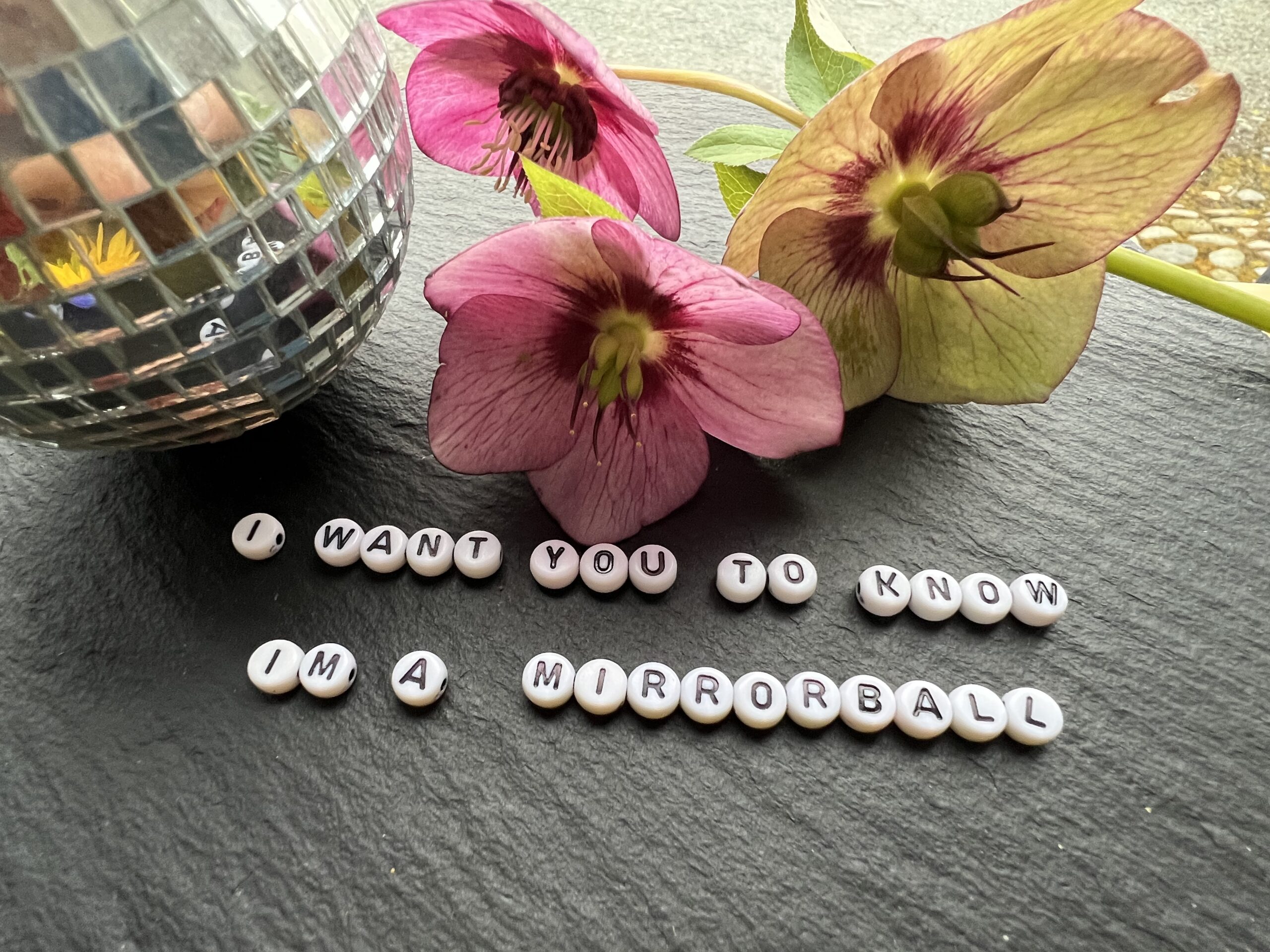
I want you to know I’m a mirrorball
For two years, I’ve been living with Post-Concussion Syndrome (PCS). And for two years, I have unknowingly been a ‘mirrorball.’
In the world of brain injury, we call it “masking.” But Taylor’s lyrics capture the exhaustion of this survival tactic better than any textbook.
“I want you to know
I’m a mirrorball
I’ll show you every version of yourself tonight
I’ll get you out on the floor
shimmering beautiful
and when I break it’s in a million pieces”. 1
I am a ‘mirrorball.’
I work tirelessly to reflect back exactly what the world wants to see, shielding others from the uncomfortable reality of my struggle. I ‘dance’ and ‘shimmer’, trying to look “normal,” simply so others feel at ease.
Since developing PCS (Post-Concussion Syndrome), this hasn’t just been a choice; it’s been my primary tool for survival. There is a line in Cruel Summer that sums up the daily lie of chronic illness perfectly.
“Said, “I’m fine,” but it wasn’t true.” 2
When people ask how I am, I almost always say, “I’m fine.” Sometimes, I say it simply because I don’t want to talk about it. Other times it’s to preserve my limited energy. But mostly, I use it as a shield. I am constantly terrified that people will lose patience because I’m not healing on a “standard” timeline. I say it because I don’t want people to get tired of me, or my injury, or my fight.
I am also exhausted by the gaslighting that happens when you look healthy but feel shattered – the way symptoms are so easily dismissed as “just” menopause or the exhaustion of motherhood. After two years, lying is easier than admitting I am still ‘breaking into a million pieces’ every single day.
I’ve realised I am even a ‘mirrorball’ in front of medical professionals.
When I see a doctor who doesn’t have the answers, when my complexity begins to frustrate them, I instinctively change tack. I stop mentioning my “weirdest” symptoms to protect them. It isn’t because I care about their feelings. I know that when a professional feels out of their depth, their insecurity often leads to notes that don’t reflect my reality.
I hide my truth so they don’t label me “difficult,” “anxious,” or “emotional” to cover for their own limitations. And as sad as it sounds, I become a ‘mirrorball’ as a shield against the permanent mark on my medical record.
I am also a ‘mirrorball’ because I want to fit in.
“I want you to know
I’m a mirrorball
I can change everything about me to fit in (…)
drunk as they watch my shattered edges glisten (…)you’ll find me on my tallest tiptoes
spinning in my highest heels, love
shining just for you.” 3
Even when the sensory overload is deafening and the dizziness is nauseating, I push through. I refuse to let this injury become my entire identity or be labelled as the person who is always “complaining.”
So, instead of showing the pain, I camouflage it. I attempt to blend in by living out the exhausting script of Taylor’s chorus. I stay on my ‘tallest tiptoes’, ‘spinning’ to hide the brain fog, the headaches, and the exhaustion. And I ‘shine’ for you.
However, I know this performance is unsustainable.
Because it isn’t just about the reflection; it’s about the invisible effort it takes to produce it and the crushing cost I pay. Tasks that sound effortless to the world – processing a conversation, standing in a brightly lit room, or maintaining eye contact – now require monumental cognitive effort. By the time the day is over, I’m not just tired; I am shattered, drained by the act of pretending to be fine.
And why do I keep doing it? Because I am terrified of what happens if I stop.
“I’m still a believer, but I don’t know why
I’ve never been a natural
all I do is try, try, try
I’m still on that trapeze
I’m still trying everything
to keep you looking at me.” 4
That is the heart of PCS. Since my injury, nothing feels natural anymore; instead, I have to keep trying. I try to follow the conversation while my head and body feel disconnected; I try to smile while my tinnitus is raging; I try to ask the right questions while the ground beneath me feels as unstable as marshmallows. I am doing everything to stay on that ‘trapeze,’ even when my vision is bouncing.
Because if I fall off the ‘trapeze’ and reveal the messy, broken reality of my life with PCS, I’m scared people will stop looking. I’m scared that if I’m not ‘shimmering,’ I’ll become invisible. So, I do everything I can to keep the world engaged, even while I am running on empty.
But after two years, I’m starting to wonder: What would happen if I stopped ‘spinning’? What if I stopped ‘shimmering’? What if I just allowed myself to be a person who is healing, rather than a person pretending to be healed?
Because the reality is that I have been so busy trying to reflect the light for everyone else that I forgot I was the one who was shattered.
Writing this post has also forced me to look backward. I can see now that I likely made others feel they had to be ‘mirrorballs’ for me, too – reflecting a version of themselves they thought I needed to see. Moving forward, I carry this lesson with newfound compassion.
So from now on, if I’m broken, I’m going to let the pieces stay right where they are. And in doing so, I hope to create a space where the people I love feel safe enough to stop performing too.
No more ‘tiptoes.’
No more ‘trapezes.’
No more ‘mirrorball.’
I don’t need to ‘shimmer’ to be seen; I just need to be me.
Because as Taylor sings,
“at least, I’m trying.” 5
The Concussion Girl
- Swift, Taylor,‘mirroball, folklore’. Taylor Swift, 2020 . ↩︎
- Swift, Taylor, ‘Cruel Summer’. Taylor Swift, 2019 ↩︎
- Swift, Taylor, ‘mirroball, folklore’. Taylor Swift, 2020 ↩︎
- Swift, Taylor, ‘mirroball, folklore’. Taylor Swift, 2020 ↩︎
- Swift, Taylor, ‘this is me trying, folklore’. Taylor Swift, 2020 ↩︎