
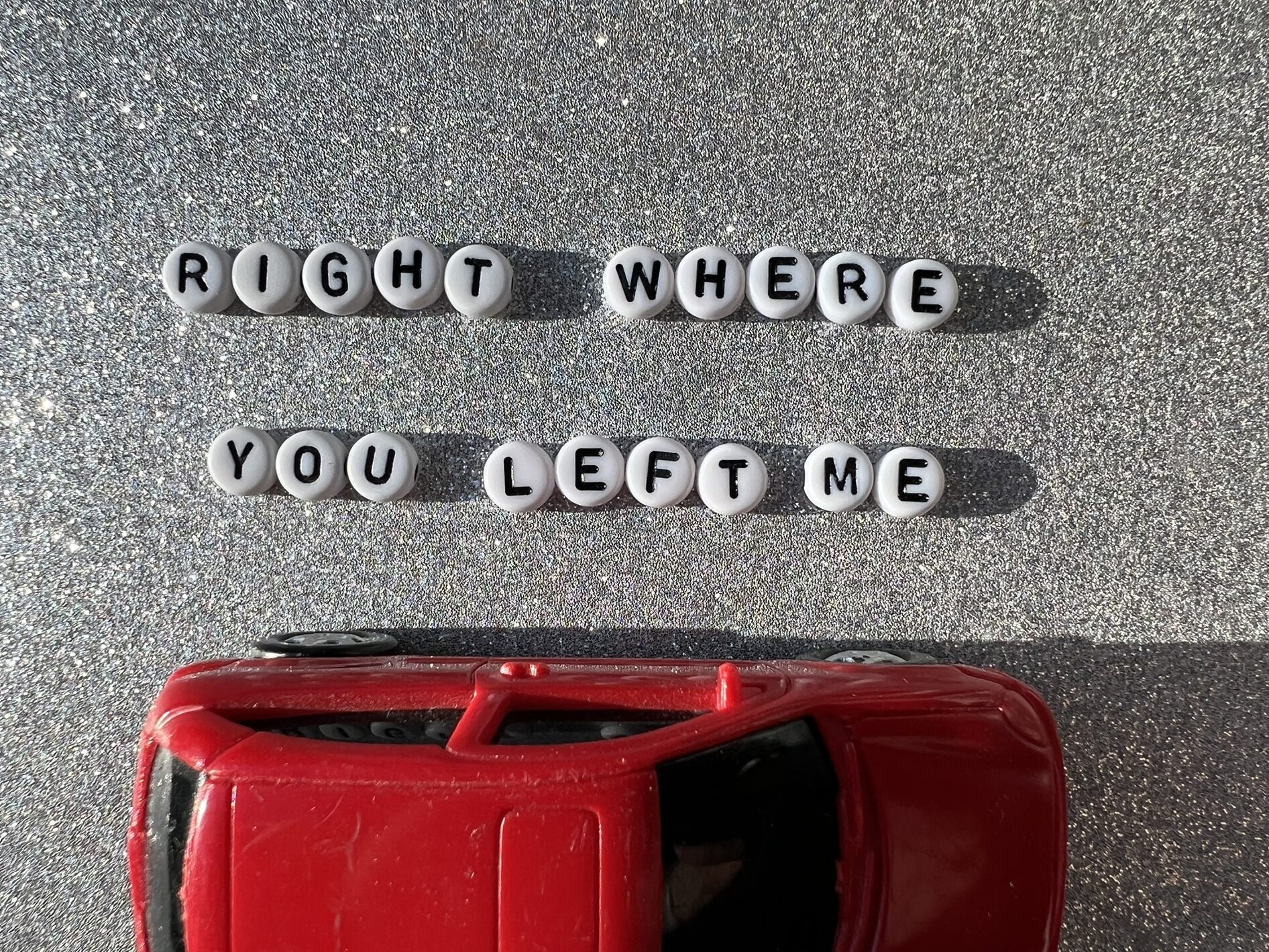
right where you left me
Ever since my crash, there’s been a common assumption that I have PTSD. It became the “easy” explanation for everything I was going through. But that label never felt right. It felt like they were trying to fit my experience into a box because it’s easier to explain it that way than to admit that no one knows anything about Post-Concussion Syndrome in the UK.
To figure out what was actually going on, I brought Taylor’s right where you left me into a therapy session. Most people see this song as a breakup song, but for me, it’s the perfect portrait of the limbo, isolation, and trauma that followed my car accident. It captures the exact moment my world froze while the rest of the world kept turning, and the trauma that came with it.
the world moved, I stayed
“friends break up, friends get married
strangers get born, strangers get buried
trends change, rumors fly through new skies
but I’m right where you left me”
While the rest of the world moved forward, my life stalled. I never truly walked away from the day of the accident. In every sense, I am still standing exactly where the car left me.
the paralysis
“help, I’m still at the restaurant
still sitting in a corner I haunt
cross-legged in the dim light
they say, “what a sad sight””
Since my accident, I have lived the exact paralysis Taylor describes. I am perpetually ‘sitting at the restaurant,’ haunted by the slow, invisible process of recovering from a brain injury. While the world keeps turning, I remain ‘cross-legged in the dim light,’ waiting for answers, just trying to survive each day.
the literal shatter
“I swear you could hear a hairpin drop
right when I felt the moment stop
glass shattered on the white cloth”
For me, the ‘glass shattered’ isn’t a metaphor for a broken heart; it’s the literal sound of the impact that I still vividly remember. In one violent second, the ‘white cloth’ of my existence was left in ruins.
the ‘dust-collected’ life
“everybody moved on
I stayed there
dust collected on my pinned-up hair
they expected me to find somewhere
some perspective, but I sat and stared”
For years, I ‘stayed there’ and lived a ‘dust-collected’ life, paralysed and on hold. I waited for medical answers that never came, and as the medical world grew frustrated, they flipped the blame onto me. They pressured me to ‘find some perspective,’ treating my recovery like a choice I hadn’t made yet. So, I remained ‘sitting and staring’ in a reality invisible to everyone but me.
the girl who got frozen
“did you ever hear about the girl who got frozen?
time went on for everybody else, she won’t know it
she’s still 23 inside her fantasy
how it was supposed to be”
For years, I suppressed my grief and my emotions just to survive. That numbness became my ‘fantasy’ – my way to avoid the process of grieving the loss of my identity. I was the girl who froze and couldn’t move on. I was clinging to a ‘fantasy’ of my former self – the ‘how it was supposed to be’ – the teacher, the sewer, the mother and the person I was meant to be before everything stopped.
the girl who lost it
“did you hear about the girl who lives in delusion?
break-ups happen every day, you don’t have to lose it”
Just as the girl in the song is told, ‘break-ups happen every day,’ medical providers dismissed my brain injury as a ‘delusion’ or a minor inconvenience. I was met with “well-meaning” comments that told me ‘not to lose it,’ as if my reaction to a life-altering trauma were disproportionate.
I wasn’t delusional; I was isolated by a clinical system that refused to look past my “functional” exterior. They saw a girl who looked fine, so they decided that I was simply a girl who had lost it.
no choice but to stay
“I’m right where you left me
you left me no, oh, you left me no
you left me no choice but to stay here forever.” 1
I was left right there, in a state I never chose, trapped in the aftermath of the moment that changed everything. Right where the NHS left me.
For years, I was told I had PTSD from the impact. But as I sat with these lyrics with my psychologist, we determined that I never actually had PTSD or anxiety from the accident itself.
When I see a car accident, I feel nothing: no trigger, no adrenaline, no anxiety. But when I see an NHS letter on our kitchen table, my heart drops. Even the sight of the postman makes me panic.
I didn’t develop a fear of cars or driving. The crash itself doesn’t haunt me. The ‘restaurant,’ where I am still sitting, isn’t the wreckage of the car. The crash was a single event, a catalyst that unravelled the rest of my life.
What I developed was a soul-crushing medical trauma. What haunts me every day is every single medical appointment I have attended since. It’s the failure of the medical system – the silence, the gaslighting, the lack of answers, and the eventual abandonment.
That is my ‘restaurant.’
And this is the incredible power of art: where the medical world fails, art doesn’t. Through Taylor’s words, I finally felt seen, validated, and less lonely. It was the beginning of my healing because it reinforced what I already knew: my symptoms are not psychologically triggered. They are concussion-led.
Taylor reminds me that even when you are stuck in your own ‘restaurant,’ art can reach in, find you, and heal.
To hear this outstanding song, go to the Official Lyric Video on YouTube.
The Concussion Girl
- Swift, Taylor. ‘right where you left me’, evermore. Taylor Swift, 2020. ↩︎