
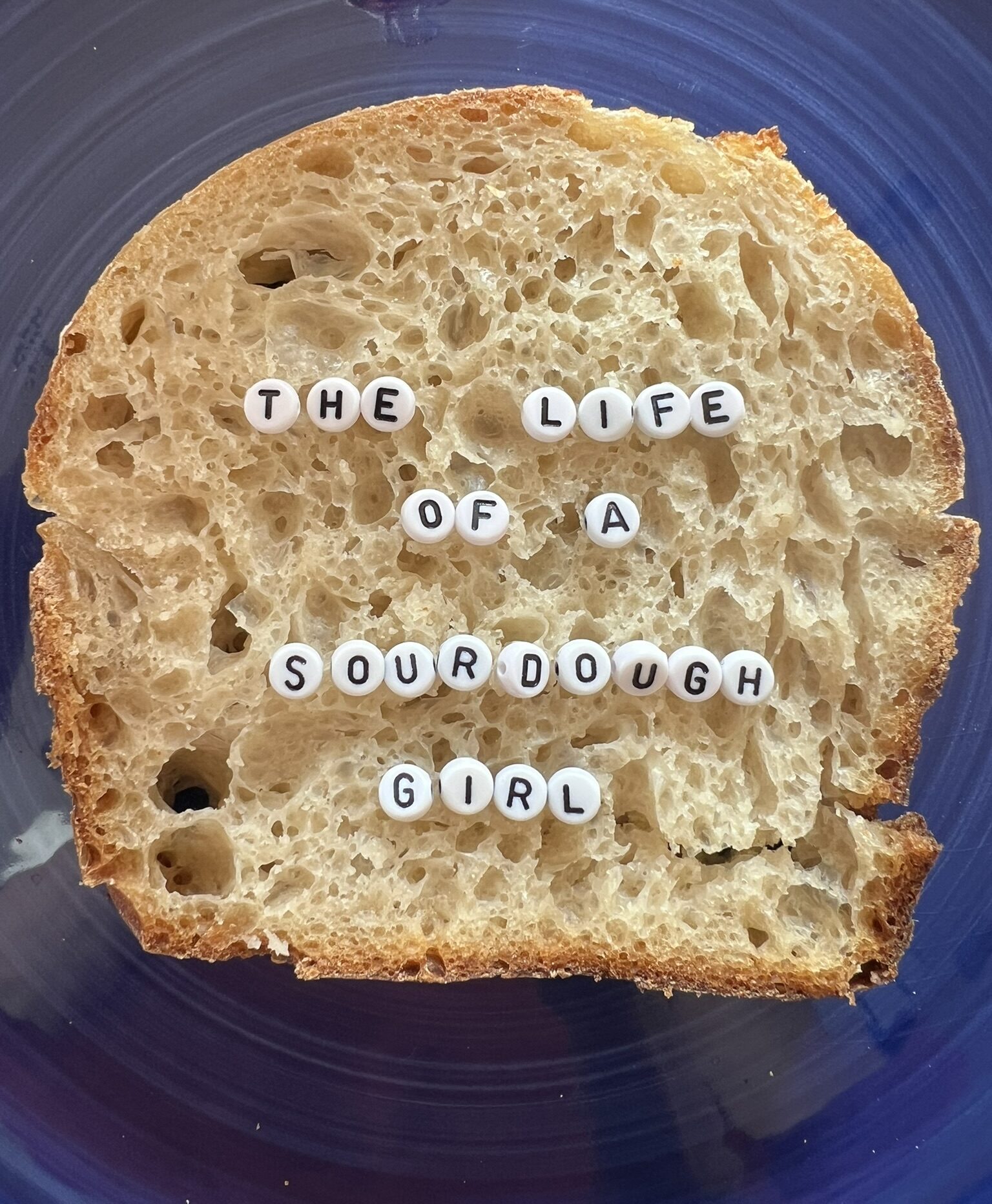
The Life of a Sourdough Girl
After my brain injury, I had to stop sewing. It sounds small to some, but for me, it was huge. It was simply too difficult to continue sewing as every stitch made my PCS symptoms worse. Because I was a talented sewer before the accident, losing that hobby felt like losing part of my identity.
The words from Taylor’s this is me trying perfectly captured my new reality.
“I’ve been having a hard time adjusting
I had the shiniest wheels, now they’re rusting” 1
I also used to have the ‘shiniest wheels‘ – I was capable, fast, and always learning and growing. But suddenly, I felt rusty. As a teacher and a maker, I’ve always defined myself by the skills I learn and the things I create. When those parts of my life were taken away, I felt like I had lost who I was.
I needed a way back, so I turned to sourdough.
This wasn’t just a hobby swap; it was a necessary adjustment for my healing. While sewing triggered sensory symptoms my brain couldn’t yet handle, sourdough offered a different rhythm. It replaced high-strain precision with a slow, tactile, and grounding craft. It allowed me to reconnect with the satisfaction of making something with my hands while listening to my brain’s limits.
But there was another reason I started baking: defiance.
When medical professionals tried to label my Post-Concussion symptoms as “just anxiety,” I chose to prove them wrong. Sourdough is notoriously difficult and unpredictable, and mastering it requires focus and resilience. Being dismissed gave me a new kind of drive.
I found myself channelling the sharp, Look What You Made Me Do energy Taylor brings to the Eras Tour stage. I can already picture myself walking out of that doctor’s office with that same level of defiance singing,
“But I got smarter, I got harder in the nick of time
Honey, I rose up from the dead, I do it all the timeOoh, look what you made me do” 2
Baking became my own way of rising. It was how I got smarter, how I got harder, and how I proved that I wasn’t hiding from life. I was just doing things differently because I needed to heal. It showed both myself and the world that my brain was still hungry, even if it was hurt. I hadn’t lost my ambition, my creativity, or my ability to learn; I just needed a different environment and the right stimulation to prove it.
Most people who know I bake don’t realise that sourdough was never just a hobby. It became the foundation of both my physical and cognitive rehabilitation.
It provided a structured way to challenge my cognitive limits and rebuild exactly what the injury had broken. Specifically, it addressed three pillars of my recovery:
1. Rebuilding the Mind (Cognitive Rehabilitation) – Because the process spans 24 to 48 hours, it works as a continuous exercise to develop my focus and discipline. Managing the specific timings for stretch-and-folds acts as a memory exercise, while calculating baker’s percentages and adjusting for temperature forces my brain to perform complex maths. This helps me restore the cognitive functions impacted by the car accident.
2. Retraining the Body (Vestibular Rehabilitation and Pacing) – Mixing ingredients requires constant hand movement and visual tracking, which still triggers my dizziness. However, performing these movements purposefully reinforces my vestibular rehab; by tracking my hands as I work, I am retraining my brain to handle motion. Sourdough also fits my current pacing strategy. Unlike tasks that require sustained focus, sourdough is broken into 10-minute bursts followed by long rests. These gaps provide the pauses I still need to prevent a crash.
3. Restoring the Soul – Sourdough is an ongoing test of my resilience. Because it is an unpredictable craft, it allows me to practice handling failure in a controlled way. Every time I bounce back from a bad loaf, I contradict the medical narrative that my mind is “fragile” or “avoidant” due to my PCS. Pulling a fresh loaf from the oven is also a physical reminder that I am more than a patient; I am a mum, a maker, and a contributor to my home.
Sourdough has been pivotal in my recovery journey, and I am deeply grateful for this new hobby. Ultimately, it has helped me realise that the core of who I am – the learner, the doer, the creative thinker – wasn’t destroyed. I just do things at a different pace now.
I can’t deny how much sourdough has impacted me. It has taught me that I don’t just make bread; the bread makes me “me” again. Putting it into Taylor’s words:
“But I can’t forget the way you made me heal”
Part of my healing came from the kindness of friends. I am grateful to Ross, who shared his starter with me and launched my sourdough journey. I don’t think he realises how much those 50 grams of starter have helped my recovery. I am also grateful to Katie; by sharing her favourite personal recipe, she gave me the final push I needed to begin.
I’ve tried and followed many different methods, but I found this video by LifebyMikeG to be the most helpful. Once I started following this specific approach, my loaves became a favourite with my family.
The Concussion Girl
- Swift, Taylor. ‘this is my trying’, folklore. Taylor Swift, 2020. ↩︎
- Swift, Taylor. ‘Look What You Made Me Do’, Reputation. Taylor Swift, 2017. ↩︎
- Swift, Taylor. ‘thanK you aIMee’, The Tortured Poets Department. Taylor Swift, 2024. ↩︎
Comments
You forgot to mention how delicious the Sourdough is too!
Good point! I get so focused on the ‘rehab’ side of baking that I forgot to mention the best part. Nothing beats a warm slice with way too much butter!
I am so proud of you
Thank you! ❤️ It feels good to be creating and slowly making things again.
What a great uplifting reminder of the difficulty but beauty of the change post injury. losing something so important but discovering a new path and healing through it is something I’m still learning how to do. You’re inspiring, thank you for sharing!!
I really appreciate you saying that. It’s a strange feeling to lose a hobby that feels like ‘you,’ but I’ve found that creativity just finds a new home. Thank you for sharing your journey with me too – we’re in this together 🫶🏻