
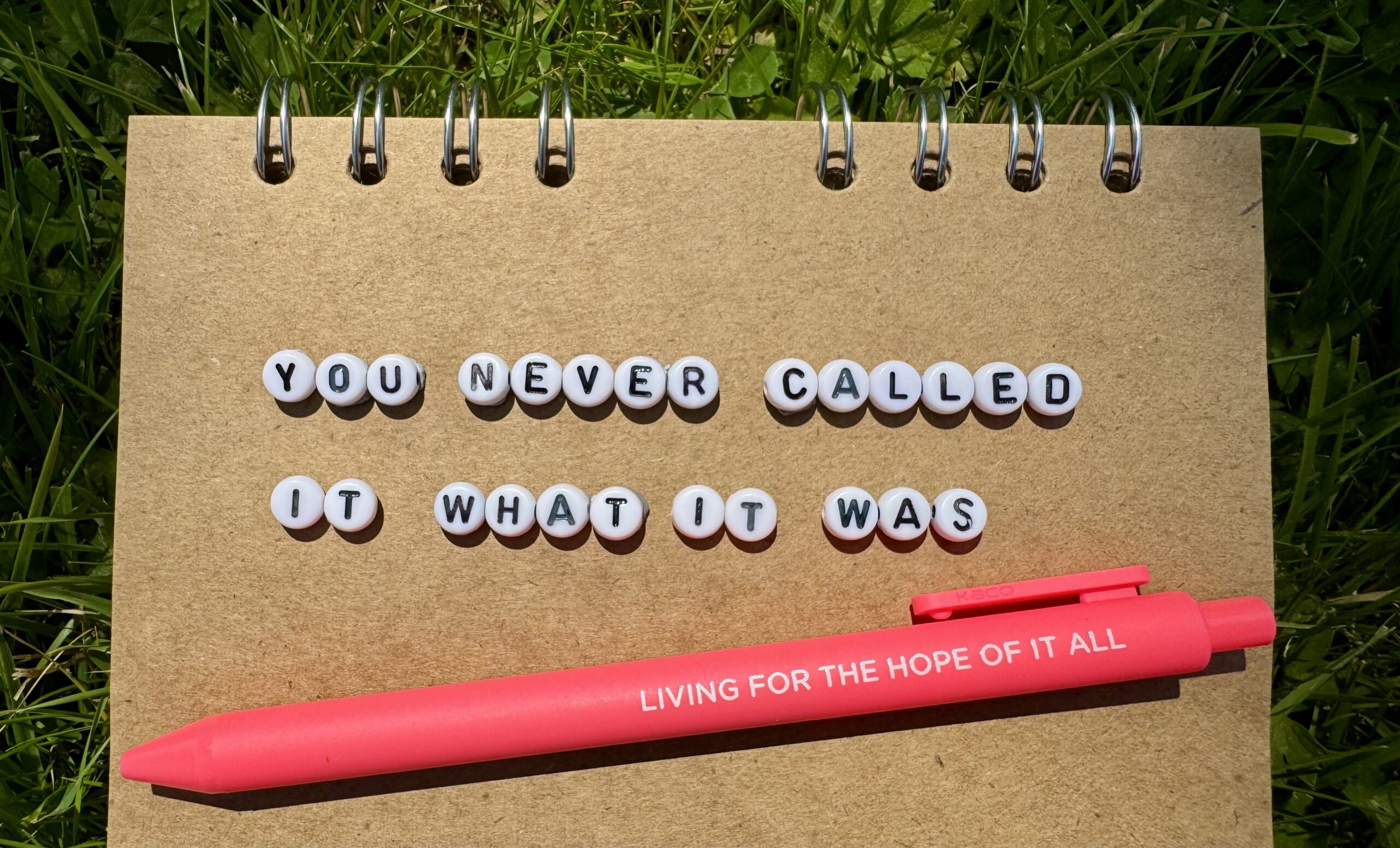
You never called it what it was
Dear NHS Medical Professionals and Specialists,
I write this letter to you in rage, in heartbreak, but also in hope. In the hope that this letter might change the way you deal with patients like me. Because as Taylor sings, despite everything I’ve gone through, I am still
“livin’ for the hope of it all.” 1
For the past two years, I have lived with Post-Concussion Syndrome (PCS). In that time, I have sought empathy, compassion, answers, and a roadmap to recovery, just like so many others living with this invisible illness in the UK.
Instead of receiving unified, evidence-based care, my reality has been disappointing, frustrating, and traumatising. I have encountered an exhausting range of contradictory opinions, outdated medical myths, and systemic medical gaslighting, all because I carry an invisible illness that no standard test can detect yet.
Your medical dismissals and interactions with me have left me deeply broken, a trauma that continues to haunt me day in, day out.
Taylor Swift puts into words accurately and devastatingly what you have done to me when she sings:
“it still hurts underneath my scars
from when they pulled me apart.” 2
You were the ones who pulled me apart when you treated my concussion as a ‘hoax’ by denying the single most critical thing that could have accelerated my recovery: a correct diagnosis. Because as Taylor sings,
“You never called it what it was.” 3
That is right. Many of you refused to call it what it truly is: a mild Traumatic Brain Injury (mTBI), and instead, you spent two years rewriting my reality.
The diagnosis of my condition has constantly been minimised, picked apart and questioned. Some of you flatly told me a concussion is not a Traumatic Brain Injury at all. Others insisted I needed a direct blow to the head or a total loss of consciousness to even qualify for the diagnosis. Some others told me that I didn’t have a brain injury because my MRI scan was clear, or insisted it was “just” standalone vestibular issues because I must have been a “sickly child”.
The failure to call it what it truly is meant that you withheld the key to my recovery. Without a roadmap, access to specialised rehabilitation, and the validation needed to heal, I was left entirely responsible for navigating a complex neurological injury alone.
Throughout my journey, you have tried to make me the problem to cover up your own lack of answers. But the problem isn’t my body, my brain, or my mind. The problem is that the medical community continues to refuse to admit what it does not know about complex neurological disorders like concussions, projecting that lack of knowledge onto us. And we pay for it.
You turn your own educational deficits into my pathology, or as Taylor puts it in Sad Beautiful Tragic:
“And you’ve got your demons, and darling, they all look like me.” 4
I have spent the last two years educating myself, and if I had the opportunity to meet you again, I would no longer sit in silence. I would argue back, dismantle your diagnoses, and reject your outdated treatments using your own governing medical standards and the UK’s leading brain injury authorities.
Because after two years,
“you made a rebel of a man’s careful daughter.” 5
So if we met again, this is exactly what I would say to you:
1. A concussion IS a traumatic brain injury.
When you tell me my injury is not a traumatic brain injury, you contradict official NHS guidance, which explicitly confirms that “a concussion is a Mild Traumatic Brain Injury (mTBI).” 6 While “mild” means it is typically not an immediate neurosurgical emergency, it is still a brain injury that involves “real temporary disturbance in the brain’s functioning.” 7
2. You do NOT need a direct hit to the head to be concussed.
When you insist I must have hit my head to be concussed, you ignore basic physics and established clinical guidelines. The NHS states that a brain injury can occur even when there are no physical signs of a head injury. 8 This is because an “mTBI is caused by the rapid acceleration and deceleration of the brain as it moves within the skull, either from blunt force or sudden change of direction,” 9 like whiplash.
3. You do NOT need to lose consciousness to have a concussion.
When you look for a history of blacking out as a prerequisite for my diagnosis, you miss the vast majority of injuries. According to data published by Headway, only around 10% of reported concussions involve a loss of consciousness. 10 The NHS reinforces this, 11 validating that an mTBI routinely occurs without any loss of consciousness or visible physical marks. 12 According to Headway, “a sense of confusion is more common” and carries the exact same diagnostic weight. 13
4. Clear MRI and CT scans do NOT rule out a concussion.
Using a clear CT or MRI scan to tell me there are “no signs of brain injury” is fundamentally misleading. Headway and the NHS explicitly state that standard CT and MRI scans are designed to look for structural emergencies, such as skull fractures, brain swelling, or major bleeding. 14
As NHS guidelines point out, brain scans cannot diagnose concussion symptoms because the damage is at the cellular level and is too small for standard imaging to pick up. 15 Moreover, Headway states, “widespread, microscopic damage can be left undetected even with the use of these scans. This does not mean that an injury has not occurred – just that we cannot see it with existing imaging methods. It is more important to focus on the symptoms being experienced after a blow to the head rather than relying on brain scans to diagnose a concussion.” 16
5. Vestibular problems ARE a symptom of the head injury.
When you isolate my dizziness, balance issues, or motion sensitivity and label them as standalone “vestibular problems,” and suggest they exist because I must have been a “sickly child,” you substitute clinical science with harmful speculation. The vestibular system and the brain work in tandem. Official NHS guidelines list struggling to balance as a primary, expected clinical sign of a concussion. 17 Post-concussion vestibular dysfunction is a direct consequence of trauma, as a concussion frequently upsets the balance organs in the ear, damaging either inner ear structures or brainstem processing pathways. 18
To conclude, I do not expect every doctor to be a concussion specialist. However, I do need the medical community to recognise the systemic gaps in education regarding mTBI in the UK.
Your words carry immense weight. When you validate a patient’s symptoms instead of dismissing them, you shift our journey away from the trauma of medical gaslighting toward a path of genuine healing.
The truth is, as hoax lays bare:
“you have beaten my heart.” 19
But because of you, I will endeavour to make changes. I will make sure that other patients in the future, like me, have a better chance in the UK to recover more quickly from a concussion.
To those medical professionals who actually listened and accepted their own clinical limitations with professional humility, thank you. You chose genuine care. Your contributions did far more than just support my recovery; they actively restored my faith in the medical profession.
You reminded me of what healthcare is truly supposed to look like, and most importantly, you called my injury exactly what it was: a concussion, Post-Concussion Syndrome, a mild Traumatic Brain Injury – an mTBI.
To the doctors who dismissed me: I am no longer waiting for your validation. You may have spent two years looking at my scans, my symptoms and my history and refusing to call it what it was, but I know the truth.
And I will call it what it is.
The Concussion Girl
- Swift, Taylor. “august, folklore.” Taylor Swfit, 2020. ↩︎
- Swift, Taylor. “hoax, folklore.” Taylor Swift, 2020. ↩︎
- Swift, Taylor. “hoax, folklore.” Taylor Swift, 2020. ↩︎
- Swift, Taylor. “Sad, Beautil, Trafic, Red.” Taylor Swift, 2012. ↩︎
- Swift, Taylor. “Mine, Speak Now.” Taylor Swift, 2010. ↩︎
- University Hospitals Birmingham NHS Foundation Trust, ‘A patient guide to mild traumatic brain injury‘ (PI23/1611/04), 2023. ↩︎
- HEADWAY – THE BRAIN INJURY ASSOCIATION, 2026. Concussion [online]. [Accessed 10 July 2026]. ↩︎
- University Hospitals Birmingham NHS Foundation Trust, ‘A patient guide to mild traumatic brain injury‘ (PI23/1611/04), 2023. ↩︎
- University Hospitals Birmingham NHS Foundation Trust, ‘A patient guide to mild traumatic brain injury‘ (PI23/1611/04), 2023. ↩︎
- HEADWAY – THE BRAIN INJURY ASSOCIATION, 2026. Concussion [online]. [Accessed 10 July 2026] ↩︎
- NHS INFORM, 2025. Concussion [online]. NHS inform. [Accessed 10 July 2026] ↩︎
- University Hospitals Birmingham NHS Foundation Trust, ‘A patient guide to mild traumatic brain injury‘ (PI23/1611/04), 2023. ↩︎
- HEADWAY – THE BRAIN INJURY ASSOCIATION, 2026. Concussion [online]. [Accessed 10 July 2026] ↩︎
- CAMBRIDGE UNIVERSITY HOSPITALS NHS FOUNDATION TRUST, 2023. Head injury going home advice [online]. CUH. [Accessed 10 July 2026] ↩︎
- CAMBRIDGE UNIVERSITY HOSPITALS NHS FOUNDATION TRUST, 2023. Head injury going home advice [online]. CUH. [Accessed 10 July 2026] ↩︎
- HEADWAY – THE BRAIN INJURY ASSOCIATION, 2023. Concussion in the workplace [online]. Headway. [Accessed 10 July 2026]. ↩︎
- NHS INFORM, 2025. Concussion [online]. NHS inform. [Accessed 10 July 2026] ↩︎
- CAMBRIDGE UNIVERSITY HOSPITALS NHS FOUNDATION TRUST, 2025. Advice for people who have been concussed [online]. [Accessed 10 July 2026] ↩︎
- Swift, Taylor. “hoax, folklore.” Taylor Swift, 2020. ↩︎