
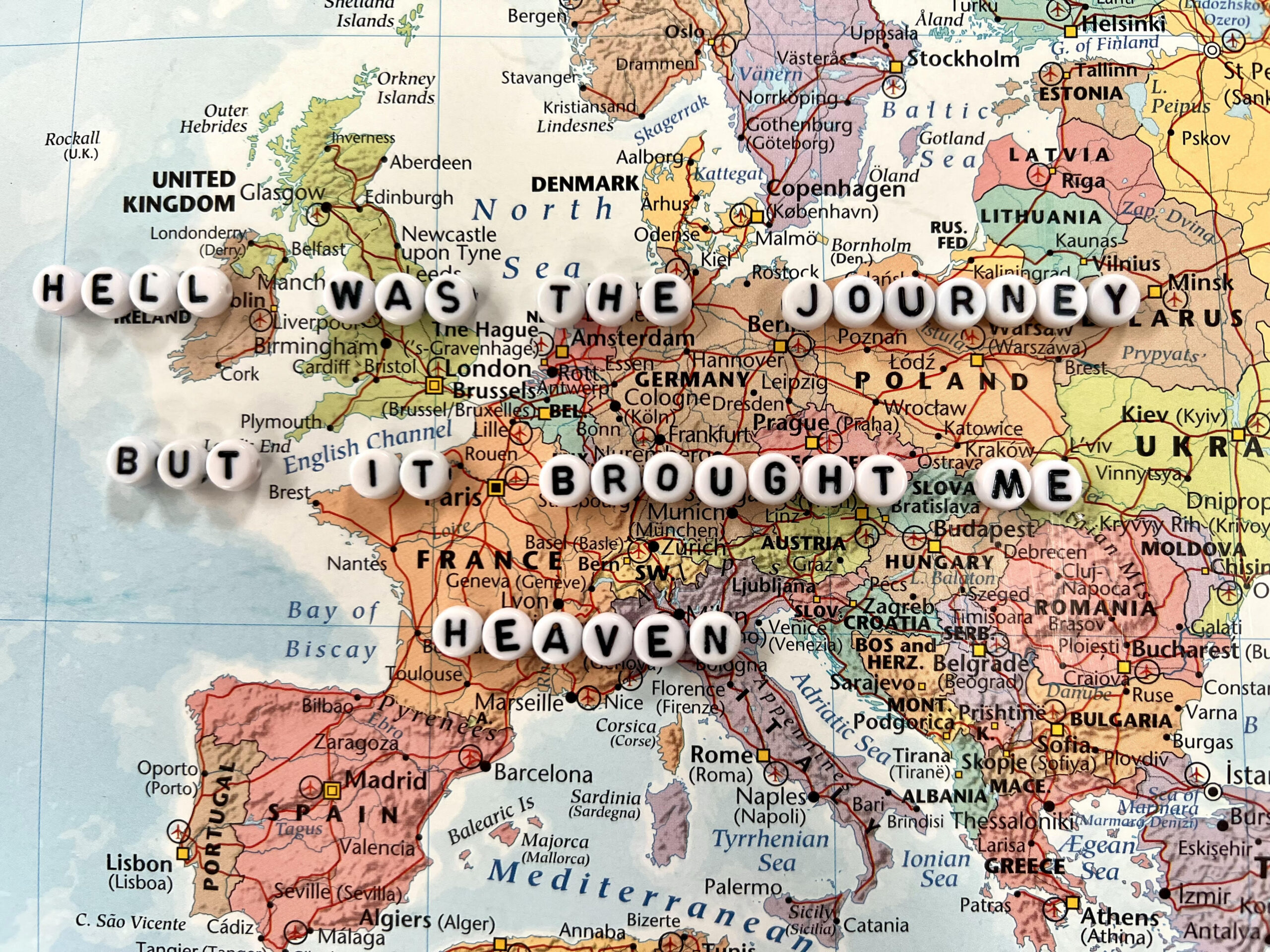
hell was the journey, but it brought me heaven
“hell was the journey but it brought me heaven” 1
Since I began struggling with concussion symptoms and vestibular issues, these words have felt incredibly literal – especially when it comes to going on holiday.
There is a common assumption that because I continue to go on holidays with my family, it’s a sign that life with a concussion “can’t be that bad.” My mum has mentioned that people see my photos and wonder, “But she’s on holiday?” I get it; to an outsider, it looks like a contradiction – if you are ill and you can’t work, why would you go on holiday?
What people don’t see is that the internal chaos in my body doesn’t stop just because I’ve changed locations. Looking “fine” in a sunny photo doesn’t mean I feel fine.
In fact, nothing about a holiday is easy when your brain is recovering.
The journey is the “hell” part of the experience. No matter how you travel, you are exposed to triggers that “feed the beast” of Post-Concussion Syndrome (PCS).
It is the sensory overload of bright airport lights or the loud, echoey noise of a train station. It’s the flight itself, where for most, ears simply “pop,” but for me, it triggers intense dizziness and a crushing head pressure that no amount of chewing can fix. Even sitting as a passenger in a car is cognitively exhausting; my brain can’t keep up with the constant movement and the flicker of passing lights. I am often drained before the holiday even begins.
Once we arrive, the routine that keeps my symptoms under control at home is gone. Between disrupted sleep, new environments, and trying to match my family’s energy, I am constantly pushing past my limit.
The truth is, going on holiday with PCS is one of the hardest things I do.
So, why do I keep doing it?
The answer is simple. Just as Taylor shares in invisible string, the holidays bring me a “heavenly” state of mind. The journey is a struggle, but the mental recharge makes the effort worth it.
These are the 5 reasons why the “heaven” outweighs the “hell.”
1. A Necessary Mental Break: Recovering from a brain injury is a full-time job or 24/7 labour of love, as I call it. Just as anyone else takes a holiday to avoid burnout, I have to do the same. Healing isn’t just physical; it’s emotional. A change of scenery provides space to process the toll this injury has taken.
2. Stepping Out of the Medical Loop: Constant appointments and medical admin carry a significant emotional weight (see my post, I’m in a new hell, every time you double-cross my mind). A holiday lowers my stress and gives my brain the quiet it needs to recover from the frustrations of the system. It also allows me to break away from the “concussion identity” I carry at home giving me breathing space to be me instead of a patient.
3. Protecting Our Family Identity: Before my injury, travel was the ‘invisible string’ that tied us together. We had traveled the world as a family long before my concussion. We want that legacy to continue for our children. By continuing to travel, we are ensuring we continue to create memories that our children will carry with them, regardless of my injury.
4. A Positive Distraction: Engaging in new experiences proves that life isn’t just about the NHS or my frustrations. It boosts my self-esteem to see I am still capable of joy.
5. The Unknown Timeline: I don’t know how long recovery will take. I cannot put my family’s life on hold indefinitely, so instead I’ve found strategies to make these trips work.
So, how do we make our holidays more ‘brain injury’ friendly?
– Easy Over Epic: I’ve traded dreams of backpacking Southeast Asia for destinations with on-site activities. This allows my husband to take the kids to the pool while I rest, ensuring everyone wins without me crashing.
– Matching the Environment to My Needs: We’ve learned that campsites in Southern Europe can be sensory overload at night. By swapping them for Northern Europe, we found the quiet we needed. Denmark, in particular, has been our perfect retreat – it’s calm, beautiful, and peaceful, and offers plenty of activities for the whole family.
– Simple Moments Over Triggers: We’ve swapped crowded museums and restaurants for outdoor activities and picnics in the park. At the beach, instead of watching the dizzying waves, I focus on grounding my feet in the sand to settle that “floaty” sensation.
– Solo Travel: We choose not to holiday with large groups. This gives us the autonomy to change our plans the second my body needs rest, without the pressure to “keep up” or explain ourselves.
– A Digital Break: I’ve learned that one medical email can ruin a trip. Now, I delete my email, NHS, and GP apps before I leave.
Overall, travelling doesn’t feel like a luxury anymore; it’s a necessity for my recovery. The “heavenly” feeling of making memories with my family is worth the “hell of the journey.” I choose to temporarily crash physically in exchange for the emotional healing my soul needs to keep going.
Next time I am in the middle of a difficult journey, I will listen to ‘invisible string’. It reminds me that the hell is temporary, but the heaven is waiting at the destination. It’s a trade I’m willing to make every single time.
“hell was the journey but it brought me heaven.” 2
The Concussion Girl
- Swift, Taylor. ‘invisible string’ folklore. Taylor Swift, 2020. ↩︎
- Swift, Taylor. ‘invisible string’ folklore. Taylor Swift, 2020 ↩︎
Comments
I struggle with Instagram, age I suppose!! But every blog I read saddens and inspires me. I’m sad for you because it’s taking sooo long but inspired by your positivity. Keep going it will get better. Love to you all x
Thank you so much, June! And don’t worry about Instagram at all—just reading your message here means the world to me. Thanks for checking in and for the encouragement, it gives me a huge boost. Sending lots of love! x